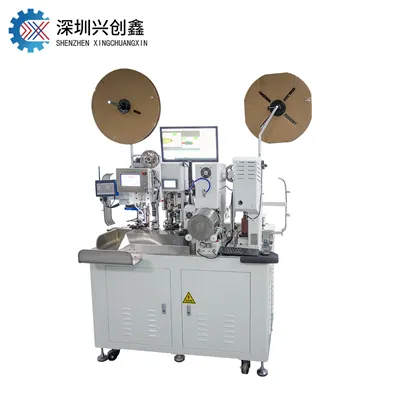
Terminal Soldering: Ensuring Stable Wire-Terminal Connections
Terminal soldering is a fundamental and critical step in wire harness production, as it directly determines the conductivity and durability of the wire harness. Soldering machines are widely used here to bond wires with different types of terminals (such as blade terminals, pin terminals, and ring terminals).
Application Scenario: In the production of automotive wire harnesses (e.g., engine wiring harnesses, chassis wiring harnesses) and electronic device wire harnesses (e.g., computer internal wiring harnesses, mobile phone charging cable harnesses), wires of different specifications (with cross-sectional areas ranging from 0.1mm² to 10mm²) need to be soldered to terminals. For example, in automotive engine wiring harnesses, copper wires are soldered to heat-resistant terminals to ensure stable power transmission under high-temperature engine operating conditions.
Types of Soldering Machines Used:
Automatic Terminal Soldering Machines: These machines integrate wire feeding, stripping, tin feeding, and soldering functions. They can automatically complete the entire soldering process for wires and terminals, with high precision (soldering position deviation ≤ 0.1mm) and efficiency (up to 300 sets of wire-terminal soldering per hour). They are suitable for large-batch, standardized terminal soldering production.
Hot-Air Soldering Machines: For terminals with special structures (e.g., sealed terminals) or heat-sensitive materials, hot-air soldering machines use controlled hot-air flow to melt the solder. This avoids direct contact between the soldering head and the terminal, preventing damage to the terminal or wire insulation, and ensuring uniform solder joint formation.
Application Advantages: Soldering machines replace manual soldering, eliminating human errors such as uneven solder amount and cold solder joints. The formed solder joints have strong electrical conductivity (resistance ≤ 0.01Ω) and mechanical strength (tensile force ≥ 50N), effectively resisting vibration, corrosion, and temperature changes, thus extending the service life of the wire harness.