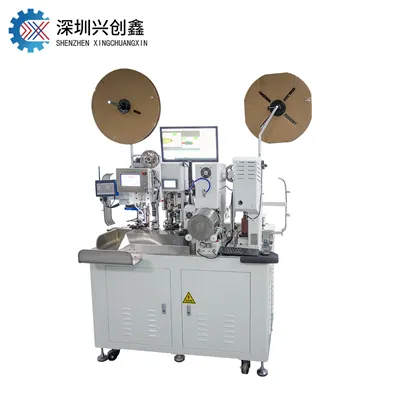
A wire cutting machine operates by automating the process of measuring, cutting, and sometimes stripping wires. Here's a step-by-step breakdown of how a typical wire cutting machine works:
1. Wire Feeding:
The wire is fed into the machine from a spool or reel. The machine uses feeding rollers or belts to pull the wire into the cutting section.
2. Measurement:
The machine is programmed with the desired length of the wire to be cut. As the wire passes through the machine, sensors or an encoder measure the length precisely.
3. Cutting:
Once the wire reaches the programmed length, a cutting blade is activated. This blade moves down or across, depending on the machine's design, to cut the wire to the desired length. The cutting process can be mechanical, pneumatic, or laser-based, depending on the machine type.
4. Stripping (Optional):
If the machine is also designed for wire stripping, after cutting, it moves the wire to a stripping station. Here, the machine removes a specified length of insulation from one or both ends of the wire. This is typically done by blades that cut through the insulation without damaging the wire itself, then pulling off the insulation.
5. Output:
The cut and stripped wire is then ejected or fed into a collection tray or conveyor for further processing or packaging. Some machines may also have automated stacking or bundling features for easier handling.
6. Control System:
The entire process is controlled by a central control system, usually a microcontroller or PLC (Programmable Logic Controller), which ensures that each step is performed with high precision. The operator can program various parameters, such as wire length, cut depth, stripping length, and batch size.
7. Automation:
High-end wire cutting machines may integrate with other production line components, such as crimping machines, marking systems, or inspection units, allowing for fully automated wire processing.
Benefits:
Efficiency: Speeds up the wire processing compared to manual methods.
Precision: Ensures consistent wire lengths and accurate cuts.
Versatility: Can handle different wire sizes and types with minimal adjustments.
These machines are commonly used in industries such as electronics, automotive, and aerospace, where precise and efficient wire processing is critical.