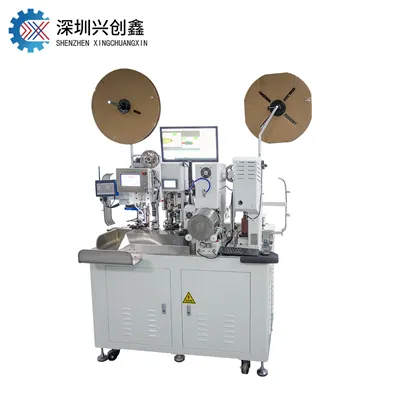
How Small Wire Harness Factories Improve Competitiveness with Wire Stripping Machines?
For small wire harness factories, the wire stripping machine is the most cost-effective "competitiveness lever". With limited investment, it directly solves four core pain points: efficiency, cost, quality, and delivery, quickly widening the gap with manual workshops.
1. Core Improvements: Efficiency & Cost (Most Direct)
Dramatically Increased Productivity, Reduced Labor
Manual work: Skilled workers produce approx. 300 pcs/hour
Fully automatic wire stripping machine: 3,000–12,000 pcs/hour (10–40x improvement)
Effect: 1 machine ≈ 6–10 workers, cutting labor costs by over 60%
Fast Changeover for Small-Batch & Multi-Spec Orders
Computer-controlled models store 10–50 sets of preset programs for one-click switching
Quick changeover in less than 2 minutes (vs. 30 minutes for manual/semi-automatic)
Advantage: Capable of accepting rush orders, mixed orders, and small-batch orders without losing profit
Stable 24-Hour Operation
Unaffected by fatigue, mood, or absences
Monthly output increased by 50%–100% with the same workshop space and headcount
2. Quality Upgrades: Threshold for High-End Orders
Stable Precision, Zero Damage
Stripping tolerance within ±0.1mm (vs. ±0.5–1mm manually)
Servo-controlled blade depth and pressure: no nicked copper cores, no residual insulation
Yield improved from ~95% (manual) to 99.5%–99.8% (machine)
Result: Fewer reworks, scraps, and claims; eligible to supply automotive, medical, and new energy supply chains
High Consistency
Uniform length and stripping port for every wire
More stable downstream processes (crimping, soldering), lowering overall assembly failure rates
3. Delivery & Order Capacity: Key to Winning Large Orders
Fast Response
Sample ready in half a day (vs. 1–2 days manually)
Small-batch orders: accepted and shipped the same day
Capability for High-Requirement Orders
Handles fine wires (0.1mm²), Teflon, shielded wires, and multi-layer sheathed cables
Reliable mass production for products that manual work cannot stably produce
Pricing Competitiveness
Lower unit cost enables more competitive quotes while maintaining profit margins
Stronger pricing advantage over manual-focused competitors
4. Selection & Implementation for Small Factories
1. Equipment Selection (By Budget & Product Line)
Entry-level (¥10,000–30,000): Computer-controlled wire cutting & stripping machines (0.1–4mm²)
Suitable for electronic wires, general harnesses, and small-batch multi-spec production
Key features: servo drive, digital settings, program storage, easy blade replacement
Mid-range (¥40,000–80,000): Fully automatic double-ended, strip-crimp or strip-tinning machines
Suitable for high-volume orders requiring double-ended stripping + crimping/tinning
Advantage: One operator can manage multiple machines, saving labor across the line
High-end (¥80,000+): Laser wire stripping machines
Suitable for ultra-fine wires, special materials (Teflon, optical fibers), multi-layer shielded wires
Advantage: Non-contact, blade-free, no core damage, ultra-high precision
2. 3-Step Implementation for Quick Results
Replace bottleneck processes first
Fully replace manual stripping with machines; start with 1–2 units
Goal: return on investment within 2 months (labor savings + output gains)
Standardization & program library
Create fixed programs for commonly used wires (UL1007, 1015, RV, shielded wires)
New operators get started in 10 minutes, reducing reliance on skilled workers
Link downstream processes
Arrange stripping + crimping/tinning in a streamlined layout to minimize handling and waiting
Gradually achieve one operator managing 2–3 machines
3. Hidden Costs to Consider
Tool life: Choose long-life blades (5,000+ meters) to save thousands monthly
After-sales support: Local manufacturers with 2-hour on-site service are more reliable than cheaper distant suppliers
Compatibility: Covers 80% of your wire specifications to avoid purchasing multiple machines
5. Final Outcome: Small Factories Competing Effectively
Cost advantage: Unit cost 30%–50% lower than fully manual production
Quality advantage: Yield of 99.5%+, eligible for high-end supply chains
Delivery advantage: Fast, stable, and flexible, increasing customer loyalty
Profit advantage: Higher profits on the same orders; lower quotes at the same profit margin
In short: For small wire harness factories looking to escape low-price competition, investing in 1–2 reliable fully automatic wire stripping machines is the lowest-cost, fastest-resulting upgrade for competitiveness.