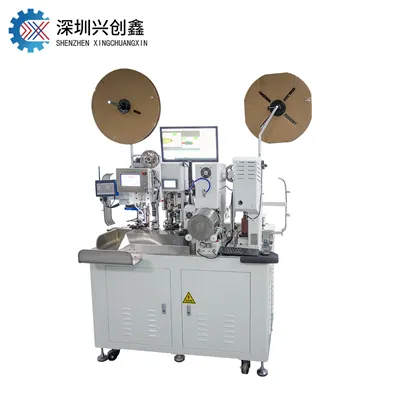
1. Working Principle
It combines the processes of splicing and crimping. Splicing refers to the joining of two or more conductive elements (such as wires), usually by overlapping them and ensuring a good electrical connection. Crimping, on the other hand, involves using mechanical force to deform a metal connector (a crimp terminal) around the spliced wires to hold them in place and provide a reliable connection.
The machine typically uses a set of dies or jaws. When the wires are inserted into the appropriate position and the machine is activated, the jaws close with a specific force and shape the crimp terminal to fit snugly around the wires. This creates a connection that is both mechanically strong to prevent the wires from separating and electrically conductive to allow the flow of current.
2. Applications
Electrical Wiring: In the installation of electrical systems in buildings, automobiles, and various electronic devices. For example, when wiring a car's electrical system, splicing crimping machines are used to connect wires that power components like lights, sensors, and the audio system. The reliable connections they create are essential to prevent electrical failures such as short - circuits and intermittent power losses.
Telecommunications: To connect cables used for data and signal transmission. In a telephone exchange or a data center, fiber - optic cables or copper wires may need to be spliced and crimped to extend lines or connect different network components. The precise connections made by these machines help to maintain high - speed and reliable communication links.
Manufacturing of Electrical Equipment: Appliance manufacturers use splicing crimping machines to assemble the internal wiring of products such as refrigerators, washing machines, and televisions. This ensures that the electrical connections within the equipment are of high quality and can withstand the normal operating conditions and vibrations that the equipment may experience during its lifetime.
3. Types of Splicing Crimping Machines
Manual Machines: These are operated by hand. They are usually portable and suitable for small - scale jobs or in situations where a high - precision manual operation is required. For example, an electrician working on a custom - made lighting fixture in a home may use a manual splicing crimping tool to make the necessary wire connections. The user has more control over the force and the position of the crimp, but the process may be slower compared to automated machines.
Semi - automated Machines: These machines have some degree of automation, such as automatic feeding of crimp terminals or pre - set force and crimping profiles. They are often used in medium - sized production lines where there is a need for a balance between flexibility and productivity. For example, a company that manufactures custom - wired control panels may use a semi - automated machine to speed up the process while still allowing for some adjustments according to the specific requirements of each panel.
Fully Automated Machines: These are used in high - volume production environments. They can handle a large number of wire - splicing and crimping operations in a short time with a high degree of precision. In a factory that mass - produces electrical connectors, a fully automated splicing crimping machine can continuously process wires, insert terminals, and crimp them without much human intervention, greatly increasing the production efficiency.