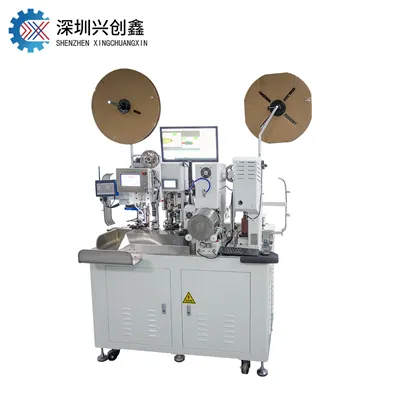
Pneumatic Terminal Crimping Machine vs Servo Terminal Crimping Machine
1. Full Comparison Table of Core Specifications
表格
| Comparison Item | Ordinary Pneumatic Terminal Crimping Machine | Closed-Loop Servo Terminal Crimping Machine |
|---|---|---|
| Driving Principle | Driven by air cylinder; open-loop without feedback. Pressure fluctuates due to compressible air. | Servo motor + ball screw; dual closed-loop feedback of torque & position. Downstroke depth and crimp force are adjusted in real time. |
| Crimping Precision | Crimp height tolerance ±0.05~0.08mm; pressure fluctuation ±12%~15%. Batch defects caused by unstable air pressure. | Crimp height tolerance ±0.01mm; pressure fluctuation ≤±3%. CPK easily reaches 1.67, fully compliant with IATF16949 automotive standards. |
| Pressure Control | Fixed crimp force, only adjustable via air cylinder pressure regulator. No crimp waveform recording or real-time process monitoring. | Equipped with ring piezoelectric CFM force monitoring. Generates pressure curves in real time; automatically halts and locks production for incomplete crimping, broken conductors or missing wires. |
| Model Changeover Efficiency | Stroke adjusted via mechanical knobs; 15–30 minutes of setup for terminal switchovers without parameter storage. | Touchscreen stores hundreds of wire programs for one-click specification switching; model changeover completed within 3–5 minutes. |
| Energy Consumption & Noise | Requires 24/7 air compressor operation; high air loss, noise level above 80dB. | No air compressor required; power output on demand, 30%~50% lower power consumption, silent operation under 60dB. |
| Data Traceability | No data storage; incompatible with MES, unable to generate production reports. | Built-in data storage, supports USB export and seamless connection to digital workshop systems; full traceability of each wire harness. |
| Applicable Wires | Ordinary low-voltage household appliance wires; unsuitable for aluminum wires, high-voltage large-cross-section wires. | New energy 800V high-voltage wires, aluminum harnesses, precision medical micro-wires, FAKRA coaxial cables, high-current energy storage wires. |
| Upfront Purchase Cost | Low: RMB several thousand to 20,000 | Premium price: RMB 30,000–100,000 (higher for fully automatic integrated machines) |
| Long-Term Operating Cost | High electricity cost for air compressors; frequent replacement of cylinder seals and pressure regulators; heavy losses from rework and defective products. | Few vulnerable pneumatic parts; defect rate reduced to under 0.1%, drastically cutting waste and material losses. |
| Flexible Production | Suitable for mass production of single fixed specifications; poor performance for multi-variety small-batch orders. | Ideal for frequent model switches, export production and OEM automotive supporting factories. |
| Customer Factory Audit | Unable to provide crimp traceability data; rejected by automotive & energy storage clients. | Complete waveform and production records; easily passes audits from vehicle manufacturers and overseas CE inspections. |
2. Pros & Cons of Pneumatic Terminal Crimping Machines
Advantages
Ultra-low entry cost, the top choice for budget-limited small workshops.
Simple mechanical structure, easy operation for workers and basic maintenance by general electricians.
Durable for light-load low-voltage wire processing.
Critical Drawbacks (Common Pain Points for Wire Harness Factories)
Unstable air pressure causes inconsistent crimping depth between shifts, resulting in broken fine conductors or insufficient tensile strength of large terminals.
No real-time pressure monitoring; defects are only detected via random manual slicing inspection, leading to mass hidden defects and customer compensation claims.
Time-consuming model changeover drastically lowers productivity for multi-spec orders.
Mandatory air compressor occupation, larger footprint, high power consumption and loud noise that may fail environmental assessment standards.
Incompatible with aluminum wires and 800V high-voltage harnesses; crimp consistency fails vehicle manufacturer standards.
No digital communication interfaces; must be fully replaced for later smart workshop upgrades.
3. Core Advantages of Servo Terminal Crimping Machines (Mandatory for High-End Wire Harness Production)
Precise closed-loop pressure control eliminates quality risks The motor adjusts torque in real time by collecting pressure data every 0.2mm during downstroke, avoiding under-crimping, over-crimping and wire core breakage. It delivers stable, oxidation-resistant aluminum wire crimping with qualified tensile strength and hexagonal crimping for high-voltage terminals.
Built-in CFM crimp waveform traceability, mandatory for automotive standards Pressure curves are automatically saved for every terminal. The machine immediately stops production upon detecting defects without full manual inspection, fully meeting audit requirements of new energy and automotive harness suppliers.
Seamless digital integration for smart factories Open communication protocols enable direct linkage with MES/WMS systems. Real-time workshop dashboard monitoring of production output and defect rates; English production reports available for export factories.
Labor, material and power cost savings Eliminates air compressors for quieter workshops; faster model switching cuts demand for senior setup technicians; drastically reduced defect rates lower waste of wires and terminals.
Universal compatibility for all special wire harness types Suitable for ultra-fine medical wires, RF coaxial cables, large-cross-section energy storage cables and 800V high-voltage shielded harnesses.
4. Selection Guide by Factory Business Type
Choose Pneumatic Machines Only If Your Factory Meets All 3 Criteria
Only produces household appliance, lighting and ordinary low-voltage power cords, no automotive or energy storage orders.
Mass production of a single fixed wire specification with rare model switches.
Small workshop with tight budget, no demand for digital transformation or third-party factory audits.
Servo Machines Are Mandatory for 4 Types of Factories
Suppliers of new energy vehicles, energy storage systems and charging piles (vehicle manufacturers require CFM pressure traceability).
Processors of aluminum harnesses, large-cross-section high-voltage cables and 0.05mm ultra-fine precision signal wires.
Factories handling small-batch multi-variety orders with frequent specification changes, aiming to mitigate labor shortages and boost changeover efficiency.
Export wire harness manufacturers or enterprises planning digital smart workshops that require traceable production data reports.