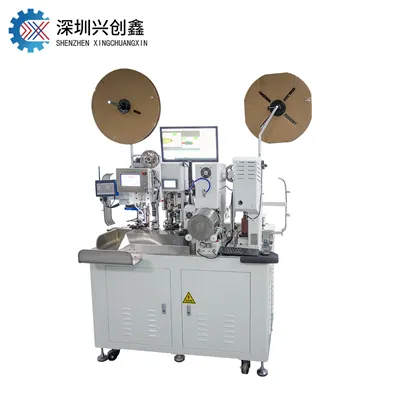
Choosing between a pneumatic wire stripping machine and a servo wire stripping machine depends on four core factors: precision requirements, wire type, production volume, and budget.
Simple conclusion:Small-to-medium batches, thick wires / ordinary wires, low cost → PneumaticHigh precision, thin wires / multi-core / shielded wires, large batches, long-term stability → Servo
1. Core Principles & Differences
Pneumatic Wire Stripping Machine
Power: Air cylinder + solenoid valve, driven by air pressure for blade opening/closing and wire feeding
Control: Open-loop / semi-closed loop, positioning via mechanical limiters and air pressure adjustment, moderate precision
Structure: Simple, low cost, fast speed, easy maintenance
Servo Wire Stripping Machine
Power: Servo motor + ball screw / timing belt, with closed-loop control (encoder feedback)
Control: Fully digital, programmable, with precise control over blade depth, length, speed and position
Structure: Complex, ultra-high precision, strong stability, feature-rich
2. Performance Comparison
| Dimension | Pneumatic Wire Stripping Machine | Servo Wire Stripping Machine |
|---|---|---|
| Stripping Precision | ±0.1~±0.5 mm | ±0.01~±0.05 mm |
| Repeatability | Average, affected by air pressure fluctuations | Extremely high, consistent performance |
| Control Method | Mechanical limit, manual adjustment | Touchscreen CNC, parameter storage, one-click switching |
| Blade Depth Control | Rough, experience-based, easy to nick inner conductors | Precise, programmable, safe for thin/multi-core wires |
| Speed | Fast (short stroke) | Fast and stable, superior in long-stroke tasks |
| Noise | Loud (cylinder impact) | Low noise, smooth operation |
| Power Consumption | Requires stable air supply (air compressor) | All-electric, energy-saving, no air supply needed |
| Maintenance | Simple (replace seals, filters) | Complex (motors, drives, encoders) |
| Price | Low (¥10,000–¥50,000) | High (¥50,000–¥200,000+) |
| Suitable Wire Size | Thick/ordinary wires (0.5–10 mm²) | Ultra-thin / thin / multi-core / shielded wires (0.03–6 mm²) |
3. Application Scenarios
Choose Pneumatic When
Wires: Ordinary PVC wires, thick wires, single-core wires, power cords, general wiring harnesses
Precision: Moderate requirements (tolerance ±0.1 mm or above acceptable)
Output: Small-to-medium batches (daily output < 5,000 pcs)
Budget: Limited, seeking cost efficiency
Environment: Already equipped with a stable air supply
Industries: Home appliances, general electronics, low-end wiring harnesses, repair workshops
Choose Servo When
Wires: Ultra-thin wires (AWG32+), multi-core wires, shielded wires, Teflon/silicone wires, coaxial cables, high-voltage harnesses
Precision: Strict high-precision requirements (within ±0.05 mm, no inner conductor damage)
Output: Large-scale, continuous production (daily output ≥ 10,000 pcs)
Quality: Prioritizing yield, consistency and stability
Functions: Multi-step stripping, mixed long/short lengths, complex profiles, data tracking, MES connection
Industries: Automotive wiring (new energy), medical, aerospace, high-end electronics, communication cables
4. Quick Selection Advice
Limited budget, ordinary thick wires, small batches, moderate precision needs → Pneumatic (best value)
Thin/multi-core/shielded wires, high precision, mass production, long-term stable manufacturing → Servo (quality choice)
5. Common Misconceptions
Pneumatic is always faster than servo → Fast in short strokes; servo is steadier and faster in long strokes & complex actions
Servo is too expensive to be cost-effective → Long-term benefits from higher yield, lower waste, fast changeover and labor savings
Servo is overkill for ordinary wires → Better for future wire upgrades, capacity expansion and quality improvement