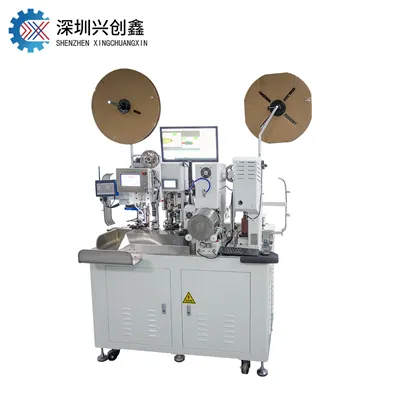
Why Ultrasonic Welding?
Superior Bonding for Aluminum Wires
Unlike crimping, which struggles with aluminum's oxide layer and softness, ultrasonic welding uses high-frequency vibrations to create a metallurgical bond without melting the base material. This ensures lower resistance and higher durability, critical for EV battery harnesses and lightweight automotive applications.
Ideal for High-Frequency Cables
High-frequency signals (e.g., in ADAS or 5G-enabled vehicles) demand minimal interference. Ultrasonic welding produces gas-tight, void-free joints, reducing signal loss compared to crimped connections, which can suffer from micro-gaps and oxidation.
Cost & Efficiency Benefits
Eliminates the need for terminals, reducing material costs.
Faster cycle times (typically 0.1–0.5 seconds per weld) and compatibility with automation boost throughput.
Sustainability & Reliability
No flux or solder required, aligning with RoHS/ELV regulations.
Consistent weld quality with real-time monitoring (force, energy, and amplitude feedback).
Challenges & Adoption Barriers
Initial investment in ultrasonic equipment is higher than crimping tools, but TCO is lower long-term.
Requires precise parameter tuning (e.g., amplitude, pressure) for different wire types.
Industry Outlook
With EVs and 5G driving demand for lighter, higher-performance harnesses, ultrasonic welding is poised to replace crimping in critical applications. Companies like Schleuniger and Sonobond are already advancing multi-wire welding systems, while OEMs (e.g., Tesla, BYD) increasingly adopt the technology.
Conclusion: Ultrasonic welding isn't just an alternative-it's the future of wire joining, offering unmatched reliability for next-gen mobility and connectivity.