EV battery packs operate at 400V and 800V, carrying hundreds of amps. Every connection inside the pack must withstand high current, constant vibration, and severe thermal cycling.
Soldering was once the default method for these connections. But as battery systems push higher voltages and faster charging, soldering's limitations are becoming impossible to ignore. Copper tape crimping is emerging as the replacement-and for good reason.
The Problem with Soldering
Soldering creates a metallurgical bond by melting filler metal. It works well for small electronics, but it struggles in high-power EV applications.
Heat damage. Soldering generates high temperatures that can damage insulation, nearby components, and battery cells.
Hidden defects. Cold joints, voids, and flux residue can pass visual inspection and continuity tests-then overheat in the field.
Higher resistance. Solder alloys typically have higher resistivity than copper. At hundreds of amps, even a small resistance increase creates heat.
Thermal fatigue. Under repeated charge-discharge cycles, solder joints can crack and degrade.
Automation challenges. Achieving consistent solder joints at high volume is difficult. Operator skill matters, and the process is hard to monitor in real time.
Material limitations. Aluminum is increasingly used in battery harnesses for weight reduction. Aluminum is difficult to solder, and copper-aluminum solder joints are prone to galvanic corrosion.
Why Copper Tape Crimping Wins
Copper tape crimping uses mechanical force to plastically deform copper tape or a terminal around conductor strands. The result is a gas-tight cold weld-no heat, no flux, no filler metal.
At proper compression-typically 75–85% of the conductor's original cross-section-the strands and terminal metal cold-weld at a microscopic level. Contact resistance can drop below 1 m Ω, often below 0.3 m Ω.
Key advantages:
Lower resistance, less heat. A gas-tight crimp minimizes resistance and heat generation.
No thermal damage. The process is cold, protecting insulation, cells, and nearby components.
Higher reliability. Crimped connections resist vibration and thermal cycling far better than solder.
Works with copper and aluminum. With the right tooling, crimping can join dissimilar materials without the corrosion risks of soldering.
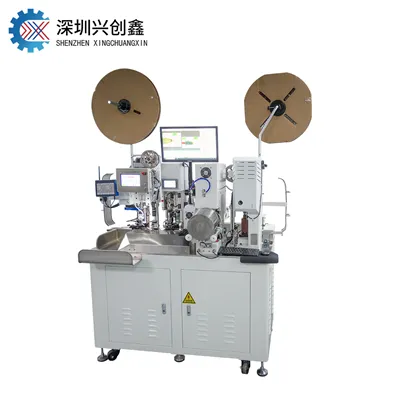
Automation-ready. Copper tape crimping machines deliver high throughput, consistent force, and real-time monitoring.
Traceable quality. Crimp force monitoring records every cycle, catching defects as they happen.
Quality You Can Prove
Modern copper tape crimping is not just about force-it's about verified quality.
Crimp force monitoring (CFM) compares every crimp to a golden waveform. Missing strands, wrong wire gauge, tool wear, and misalignment are detected instantly.
Pull testing confirms mechanical strength. Micro-section analysis verifies internal compression and void-free connections. Contact resistance testing proves electrical performance.
For automotive and EV applications, this level of documented quality is becoming mandatory-not optional.
What to Look For in Copper Tape Crimping Equipment
Precision force and crimp height control
Real-time crimp force monitoring
Tooling for copper tape, terminals, and large cable sizes
Easy integration with automated production lines
Local service, spare parts, and technical support
Compliance with IPC/WHMA-A-620 and automotive standards
As EV battery packs move to higher voltage, higher current, and lighter materials, soldering cannot keep up. Copper tape crimping delivers lower resistance, higher reliability, and scalable automation-without the heat damage or hidden defects of solder joints.
It's not just a trend. It's the new standard for EV battery harness connections.