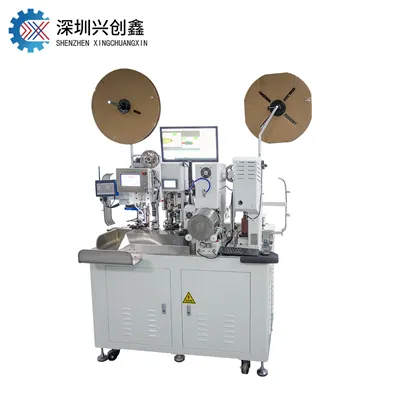
For wire harness factories purchasing wire stripping machines for the first time, the core principle is to "match your own production capacity, fit the wire type, and balance usability and long-term costs". There is no need to pursue high-end parameters. Focus on the following 5 core parameters to avoid buying the wrong one, overpaying, or purchasing one that is not useful. Beginners can directly refer to them.
1. Adaptable Wire Gauge Range (Most Core, Determines Usability)
This is the primary parameter, which directly determines whether the wire stripping machine can handle all the wires in your factory. Buying the wrong one will make it completely unusable and waste costs in vain.
Focus on two indicators: minimum wire diameter (mm)/maximum wire diameter (mm), or the corresponding core cross-sectional area (mm²) and AWG specification (commonly used for foreign trade orders).
Practical Advice: Common wires in wire harness factories are mostly 0.1mm² (thin electronic wires) - 10mm² (power main wires). For the first purchase, it is recommended to choose a model with a range of 0.08mm² - 16mm², which covers most conventional wire harness needs and avoids inability to adapt to newly added wires later. If your main product is automotive wire harnesses (with many thick wires), you can expand the range to 25mm².
2. Stripping Length and Precision (Determines Wire Harness Quality)
Wire harness processing has high requirements for stripping precision. Stripping too short makes it impossible to connect wires, while stripping too long wastes wires and affects assembly. Especially for precision electronic wire harnesses, precision directly determines the product qualification rate.
Key Focus: Minimum stripping length (usually 0.5-1mm), maximum stripping length (conventional 10-50mm, customizable for special needs), and precision tolerance (conventional ±0.1mm, ±0.05mm for precision wire harnesses).
Practical Advice: Beginners do not need to pursue extreme precision (the higher the precision, the higher the price). If processing conventional household appliance or automotive low-voltage wire harnesses, ±0.1mm is sufficient. If producing precision electronic wire harnesses (such as medical and consumer electronics), then increase the precision requirement.
3. Processing Speed (Matches Production Capacity, No Waste or Freezing)
Speed is directly related to daily production capacity. Choosing a too-fast machine wastes electricity and increases costs, while choosing a too-slow one cannot keep up with the production schedule. It is necessary to accurately match it with your daily output (refer to the previous production capacity calculation method).
Key Focus: Number of pieces processed per minute (pcs/min). Different models have great differences in speed, corresponding to the following production capacities (8-hour working system):
Small Computerized Wire Stripping Machine (suitable for small batches): 10-30 pieces/minute, daily output 4,000-11,000 pieces
Medium-High Speed Automatic Wire Stripping Machine (suitable for large batches): 30-60 pieces/minute, daily output 14,000-28,000 pieces
Practical Advice: For the first purchase, if the daily output is less than 10,000 pieces, a small machine is sufficient; if the daily output is 10,000-30,000 pieces, choose a medium-high speed machine; if it exceeds 30,000 pieces, consider a high-speed machine to avoid "using a large machine for small tasks" which increases purchase and use costs.
4. Compatibility of Blades and Molds (Reduces Long-Term Consumable Costs)
Wire harness factories will frequently replace blades and molds in the later stage. If the model has poor compatibility, consumables are difficult to purchase and expensive, which will greatly increase long-term operating costs. This is the point most easily overlooked by beginners.
Key Focus: Blade type (general V-shaped blades are preferred, suitable for most single wires; flat blades/circular blades are suitable for flat wires and multi-core wires), whether the mold specifications are universal, and whether consumables (blades, guide sleeves) are easy to buy in the market and have optional third-party alternatives (third-party consumables are 30%-50% cheaper than original ones).
Practical Advice: Prioritize models with universal blades and molds, and avoid niche models (consumables are difficult to buy and expensive); confirm that the model supports blade grinding (which can extend blade life and reduce consumable costs).
5. Functional Configuration (Choose on Demand, No Wasted Money)
The more functions a wire stripping machine has, the higher the price. Beginners do not need to pursue "full functions", but only choose the functions necessary for their own production to avoid paying extra for unused functions.
Choose core functions on demand:
Basic Necessity: Single-end/double-end stripping (most wire harnesses require double-end stripping, which is a must-have)
Common Bonus: Wire twisting (a must-have for multi-core wires to avoid loose cores), wire cutting (integrated wire cutting + stripping, reducing processes)
Optional: Tin dipping (if the wire harness needs tin dipping treatment, you can directly choose a model with tin dipping function to avoid adding additional equipment later)
Not Recommended: Beginners do not need to choose high-end functions such as automatic loading and unloading and multi-wire parallel processing (high price, complex operation, not useful in the initial stage).
Additional Reminders for Beginners' Purchase
In addition to the above 5 parameters, pay attention to two more points: ① Operation difficulty (prioritize models with Chinese interfaces and simple debugging to reduce workers' learning costs); ② After-sales guarantee (choose brands with local after-sales service and a warranty of more than 1 year to avoid production impact due to no maintenance when the machine breaks down later).
Summary: For the first purchase, the core is "adapting to wires, matching production capacity, easy purchase of consumables, and sufficient functions". There is no need to pursue high-end products; the most cost-effective and practical choice is the one that fits your own production needs.