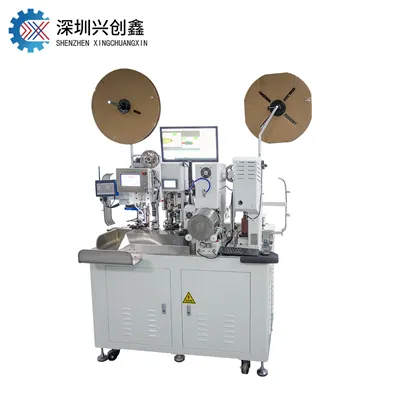
A wire stripping machine doesn't fail overnight. It degrades slowly-first a few nicked strands, then inconsistent strip lengths, then breakdowns that interrupt production at the worst possible time.
Most manufacturers wait until the machine stops working entirely before replacing it. That's a costly mistake. By the time a stripper is completely unusable, you've already paid for it many times over in scrap, rework, downtime, and lost orders.
Here are five clear signals that it's time to upgrade-before your equipment costs you another order.
1. Your Scrap Rate Is Climbing
It starts small. A few wires with nicked conductors. Occasional insulation left on the strip. Strands that break during crimping because the stripping blade cut too deep.
Over weeks, the numbers creep up. Your scrap rate goes from 0.5% to 2%, then 3%. Rework labor increases. Material waste accumulates. And every defective wire represents wasted copper, wasted insulation, and wasted operator time.
The real cost: A 2% scrap rate on 100,000 wires per year means 2,000 defective pieces. At $0.80–1.50 per rework, that's $1,600–3,000 annually-enough to fund a significant portion of a new machine.
The fix: If your current stripper cannot consistently hold strip length tolerance and blade depth without constant adjustment, it's time to upgrade.
2. You're Paying More for Labor Than You Should
Manual and semi-automatic stripping is labor-intensive. An operator feeding wires one at a time, adjusting strip length by hand, and inspecting every piece is not a sustainable model for growing production.
Manual stripping processes roughly 80–120 wires per hour. A quality automatic stripping machine handles 800–1,500 per hour-10 to 17 times faster. One machine can replace multiple operators, or free your existing team to focus on higher-value tasks like crimping, assembly, and quality control.
The real cost: If you're paying two operators $35,000 each to strip wires manually, that's $70,000 per year. An automatic machine that replaces one operator typically pays for itself within 6 to 12 months.
The fix: If labor costs are rising faster than your output, automation isn't a luxury-it's a necessity.
3. Breakdowns Are Becoming Routine
Every machine needs maintenance. But there's a difference between scheduled maintenance and constant firefighting.
If your stripper requires weekly adjustments, frequent blade replacements, and emergency repairs that stop production, it's no longer saving you money. It's draining it.
Unplanned downtime is one of the most expensive problems in manufacturing. Large plants can lose thousands of dollars per hour when a line stops. Even a small shop faces idle labor, delayed orders, and missed deadlines-costs that quickly exceed the price of a new machine.
The real cost: 40 hours of unplanned downtime per year, at $500 per hour in lost production, equals $20,000. That's more than most quality stripping machines cost.
The fix: If you're spending more time fixing the machine than running it, the machine is the problem.
4. Your Production Mix Has Outgrown the Machine
Your business evolves. Maybe you've added new wire gauges. Maybe you're processing thicker cables for EV applications. Maybe you've taken on a contract requiring multi-conductor cables, twisted pairs, or shielded wire.
If your current stripper can only handle a narrow range of wire sizes-or requires manual changeover that takes 30 minutes every time you switch gauges-it's holding your business back.
The real cost: Turning down orders because your equipment can't handle the wire is the most expensive form of downtime. You're not just losing production-you're losing market opportunities.
The fix: If your machine's capability lags behind your customer requirements, upgrade to a model with a wider processing range and faster changeover.
5. Quality Requirements Have Tightened
Five years ago, a visual inspection might have been enough. Today, your customers want documented crimp quality, pull-force test results, and traceability. Automotive, aerospace, and medical customers require compliance with IPC/WHMA-A-620-and they want proof.
An older stripping machine may produce acceptable results most of the time. But "most of the time" doesn't pass an audit. It doesn't satisfy a customer who requires measurable consistency on every piece. And it doesn't protect you when a field failure triggers a warranty claim.
The real cost: A single rejected shipment can cost more than a new machine. A single field failure can cost a customer relationship.
The fix: If your equipment can't deliver documented, repeatable quality that meets current standards, you're gambling with your reputation.
What to Look for in a Replacement
When upgrading, focus on what matters most:
Precision - strip length tolerance, blade depth control, and the ability to handle fine strands without nicking
Throughput - wires per hour, changeover time between gauges, and ease of setup
Processing range - wire gauges, insulation types, and cable constructions you can handle
Integration - can it connect to downstream crimping or marking equipment?
Support - local service, spare parts availability, and technical training
Your wire stripping machine isn't just a tool-it's a production asset. When it stops performing, it stops earning. The five signs above are not just maintenance reminders. They're financial warnings.
If you recognize your operation in two or more of these signs, the question isn't whether you can afford a new machine. It's whether you can afford to keep running the old one.