The automotive industry is accelerating its exploration of new directions. On one hand, traditional gasoline-powered vehicles are fiercely competing in the price market; on the other hand, the new energy vehicle industry chain continues to expand. Similar to traditional gasoline-powered vehicles, core product manufacturing, multi-functional modules, and vehicle assembly are crucial processes in automobile manufacturing, determining vehicle quality and intelligence. However, the greener and more electrified characteristics of new energy vehicles, relying on related automotive electronics, the assembly and manufacturing of the three-electric systems (battery, motor, and electronic control), lightweight wiring harness processing, and the application of new dispensing and injection technologies, are disrupting the traditional automotive manufacturing industry chain, opening up new markets for equipment and processes, and becoming a new blue ocean in the automotive electronics manufacturing field.
As new energy vehicles enter a period of rapid growth, the automotive wiring harness industry continues to grow. Due to the complexity of the electrical systems in new energy vehicles, more wires and cables are needed to transmit electrical energy. For example, in battery management systems, more wiring harness components are needed to connect numerous sensors to monitor battery parameters such as charge, voltage, and temperature. Meanwhile, new energy vehicles also need to possess features such as fast charging and high power output, requiring more high-voltage wiring harnesses to provide high-voltage power to the vehicles. However, the characteristics of high voltage/high current and a large number of large-diameter wires present challenges in terms of safety, wiring, shielding, weight, and cost, resulting in a high technical threshold. The value per vehicle for high-voltage wiring harnesses is also higher than that of gasoline vehicles.
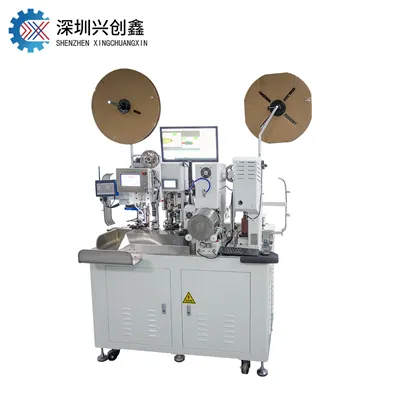
To meet the demands of the new energy vehicle market, excellent wiring harness components should possess characteristics such as good conductivity, high temperature resistance, oil resistance, and corrosion resistance. These all require the support and guarantee of wiring harness processing technology. Therefore, wiring harness processing is particularly important in the new energy vehicle manufacturing industry chain, as it determines the quality, performance, and reliability of the wiring harness. Wiring harness equipment manufacturers also need to continuously improve their technical level and production capacity, including achieving higher levels of automation, higher production efficiency, and higher reliability, while adapting to the processing of new electrical wires.