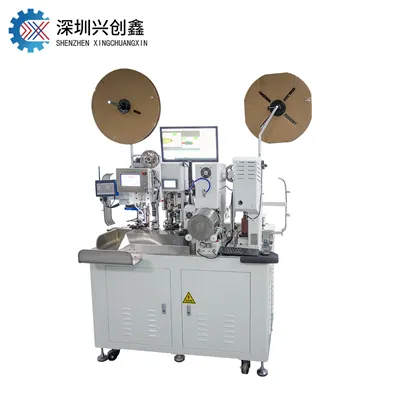
The material selection for terminal machine blades is crucial to their service life, crimping quality, and production efficiency. The following is an analysis of the main material types suitable for terminal machine blades and their characteristics:
I. Commonly Used Mold Steels
DC53 Mold Steel
Characteristics: Toughness is twice that of Cr12MoV, hardness HRC56-60
Advantages: Good fatigue resistance, less carbide segregation
Limitations: May still crack under thin-wall blade or high-stress working conditions
LG Mold Steel
Toughness is 8-9 times that of DC53
Hardness HRC54-58
Uniform structure with no carbide segregation
Outstanding advantages:
Application results: Customer feedback indicates a service life of more than 1 million cycles without chipping
8566 Mold Steel
Toughness is 4 times that of high-speed steel SKH-9
Hardness HRC58-60
Performance characteristics:
Applicable scenarios: Working conditions with higher requirements for hardness and wear resistance
II. Solutions for Special Working Conditions
Stainless steel terminal processing:
LG mold steel is recommended to solve the problem of DC53 being prone to wear
Thin-wall blade design:
Priority should be given to high-toughness materials such as LG to avoid cracking at the bottom of the V-shaped groove
High-frequency production:
Use 8566 mold steel; service life can be increased by 4 times compared with DC53
III. Core Indicators for Material Selection
Indicator Required Range Testing Method
Hardness HRC54-60 Rockwell hardness tester
Bending strength ≥3000MPa Three-point bending test
Impact toughness ≥50J/cm² Charpy impact test
Wear resistance <0.01mm per 10,000 cycles Weight loss method measurement
IV. Material Treatment Processes
Heat treatment:
Vacuum quenching + multiple tempering
Ensure hardness uniformity deviation ≤1HRC
Surface strengthening:
TD treatment (vanadium carbide coating)
Diamond coating (DLC)
Can increase service life by 2-3 times
V. Failure Analysis and Improvement
Common failure modes:
Chipping (insufficient material toughness)
Wear (insufficient hardness or wear resistance)
Fatigue fracture (excessive grain boundary impurities)
Improvement directions:
Switch to high-purity electroslag steel
Optimize the heat treatment process curve
Add surface strengthening treatment