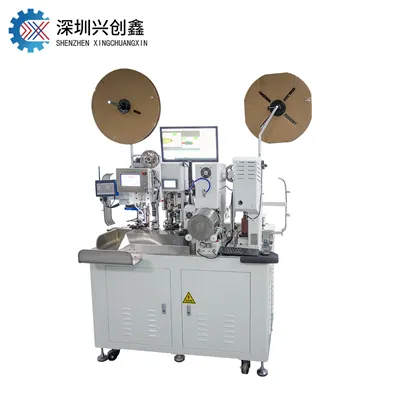
1. Basic Structure and Working Principle of Crimping Molds
Terminal crimping molds are core components in wire harness processing. Their basic structure typically includes:
Upper die assembly: includes the punch (crimping punch), guiding mechanism, etc.
Lower die assembly: consists of the anvil (crimping die), positioning device, etc.
Adjustment system: used to adjust crimping height and position
Guiding mechanism: ensures precise alignment of the upper and lower dies
Working principle: Through mechanical pressure, the metal terminal undergoes plastic deformation to form a reliable electrical connection and mechanical fixation with the wire conductor.
2. Main Mold Types Classified by Terminal Type
2.1 Open-Style Terminal Crimping Molds
Functional features:
1.Used for U-shaped, fork-type, and other open terminals
2.Simultaneously complete terminal curling and conductor crimping
3.Typical applications: blade terminals, ring terminals
2.2 Closed-Style Terminal Crimping Molds
Functional features:
Used for O-type, tubular, and other closed-structure terminals
Require pre-forming before crimping
Typical applications: closed-end connectors, waterproof terminals
2.3 Insulation Displacement Terminal Molds
Functional features:
Special blade design pierces through the insulation layer
Insulation stripping and conductor connection completed in one operation
Typical applications: IDC connectors, communication terminals
3. Mold Types Classified by Functional Characteristics
3.1 Standard Crimping Molds
Structural features: universal design
Applicable scenarios: high-volume production of conventional terminals
Advantages: low cost, easy maintenance
3.2 Compound (Multi-Stage) Crimping Molds
Structural features: multi-station integrated design
Functional features:
Complete multiple processes in one stroke
Can integrate cutting, stripping, and crimping functions
Typical applications: automotive wire harness automated production
3.3 Precision Crimping Molds
Structural features: high-hardness materials, precision guiding
Performance indicators:
Crimping accuracy: ±0.02 mm
Service life: over 1 million cycles
Application fields: medical, military, and other high-end wire harnesses
4. Special-Function Mold Types
4.1 Waterproof Terminal Special Molds
Special design:
Sealing ring crimping structure
Precise control of rubber deformation
Functional verification: Must pass IP67 or higher waterproof testing
4.2 Dual-Crimp Molds
Working mode:
First crimp the conductor, then crimp the insulation
Two stages with independent control
Advantages: prevents over-compression of the insulation layer
4.3 Adjustable Molds
Core features:
Stepless adjustment of crimping height
Quick changeover to adapt to different wire diameters
Applicable scenarios: low-volume, multi-variety production
5. Mold Materials and Surface Treatment Technologies
Common base materials:
Tool steels: SKD11, DC53, etc.
Cemented carbides: tungsten steel series
Powder metallurgy materials: ASP series
Surface treatments:
TD treatment (vanadium carbide coating)
Diamond-like carbon coating (DLC)
Low-temperature ion sulfidation
Performance comparison:
Service life of conventionally heat-treated molds: 100,000–300,000 cycles
Service life of surface-treated molds: 500,000–1,000,000 cycles
6. Key Points for Mold Selection
Terminal compatibility:
Confirm the specification drawings provided by the terminal manufacturer
Verify compatibility testing between terminals and molds
Wire diameter adaptation range:
Check the wire diameter range specified for the mold
Consider wire tolerance and insulation thickness
Equipment compatibility:
Confirm interface dimensions with the crimping machine
Check whether pressure requirements match
Production efficiency requirements:
Choice between single-station and multi-station molds
Consider die changeover time and difficulty
7. Maintenance and Care Standards
Daily maintenance:
Lubricate guide parts before each use
Remove metal debris from mold surfaces
Check whether fasteners are loose
Regular maintenance:
Full disassembly and inspection after every 50,000 crimps
Measure wear on critical dimensions
Perform surface repair when necessary
Storage requirements:
Apply rust-preventive oil and store in a sealed condition
Keep in a constant-temperature, dry environment
Avoid stacking to prevent deformation
With connectors moving toward miniaturization and high density, crimping mold technology continues to innovate. Modern high-end molds have begun integrating sensors that monitor crimping force and displacement curves in real time, ensuring quality consistency at every crimping point. Correct selection and proper use of crimping molds are essential for ensuring the reliability of wire harness connections and production efficiency.