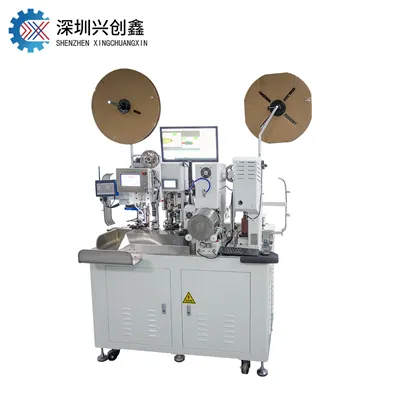
In 2026, humanoid robots are entering mass‑production at ten‑thousand‑unit volumes, transitioning from lab prototypes to commercial deployment. Most public attention centers on reducers, servo motors and large‑model algorithms. Yet special wire harnesses - the "blood vessels and nerves" tucked inside robot joints - have become a hidden bottleneck limiting overall machine reliability. Unlike harnesses for conventional industrial robots, humanoid‑robot harnesses must endure millions of joint‑twist cycles, repeated bending in confined spaces, and simultaneous transmission of power and multi‑channel signals. Material advances in cables themselves are in turn forcing comprehensive technical upgrades across the full spectrum of wire‑harness processing equipment.
A full‑size humanoid robot carries dozens of harness assemblies across its dexterous hands, neck, torso and limb joints. These range from ultra‑fine sensor signal wires of 0.08‑0.3 mm² to power‑circuit cables. High‑flex, torsion‑resistant composite shielded cables are widely adopted, required to withstand over 5 million bending cycles without conductor breakage, with bending radius compressed to 5‑8 times the cable outer diameter, while meeting strict requirements for lightweighting, anti‑interference and fatigue resistance. Conventional processing logic for industrial wire harnesses can no longer satisfy production requirements for these special humanoid‑robot harnesses.
Four Major Shortcomings of Conventional Harness Equipment Exposed by Special‑Harness Mass Production
Traditional terminal crimpers, wire strippers and cutting machines were developed for automotive and standard industrial‑robot harnesses. They exhibit obvious process defects when processing special cables for humanoid robots.
1. High risk of conductor damage when processing ultra‑fine high‑flex cables Humanoid robots extensively deploy multi‑stranded ultra‑fine conductors with modified PUR and FEP super‑soft jacketing materials. Conventional equipment features uncontrollable clamping force during wire feeding, which easily crushes or stretches cables. Insufficient depth precision of stripping blades frequently nicks internal fine copper strands and damages braided shielding layers. Hidden conductor damage is hard to detect during factory testing. Nevertheless, prolonged cyclic bending and twisting of the robot in service will trigger wire breakage and signal packet loss, directly causing complete machine failures.
2. Sharply increased difficulty of multi‑step stripping for multi‑layer shielded composite cables Joint harnesses for robots largely adopt dual‑layer shielding structures combining aluminum foil and copper braid. Production requires sequential stripping of outer jacket, shielding‑layer treatment and insulation removal in multiple successive operations. Traditional equipment cannot perform controlled‑depth stepped stripping. It either severs the shielding braid and compromises shielding performance, or delivers incomplete stripping. Burrs and loose strands after shielding‑layer handling create potential short‑circuit hazards.
3. Micro‑terminal crimping raises higher barriers for closed‑loop equipment control Connectors inside dexterous hands and joints are miniaturized. Tolerance for crimp height is tightened to ±0.05 mm, far stricter than specifications for automotive harnesses. Pneumatic terminal machines suffer fluctuating pressure and cannot output stable crimp parameters. Over‑crimping or under‑crimping leads to contact‑resistance drift under vibration and repeated torsion, which in turn causes unstable signal transmission. Under mass‑production conditions, full data logging for every crimp joint is mandatory to support traceability of complete robot units, a function barely achievable on legacy standalone machines.
4. Slow change‑over on traditional production lines fails to keep pace with fast R‑D iterations Humanoid‑robot hardware designs iterate rapidly with frequent changes to harness specifications. Early‑stage production is characterized by high‑mix low‑volume manufacturing. Traditional harness production lines involve cumbersome die replacement and lengthy commissioning cycles, which struggle to meet prototype and small‑batch trial‑production lead times and slow down iteration of complete robot units.
Downstream Harness Demands Drive Three Major Upgrade Directions for Harness‑Processing Equipment
Pain points in special‑harness mass production push upstream processing equipment to evolve from "basic processing capability" toward precision controllability, flexible adaptability and full‑data traceability.
1. Cutting & Stripping Equipment: Force‑Feedback Closed‑Loop + High‑Precision Blade Sets for High‑Flex Shielded Cables
Next‑gen cut‑and‑strip machines abandon fixed blade‑depth settings and adopt force‑feedback and real‑time laser displacement sensing to dynamically accommodate highly flexible cables. For ultra‑fine conductors and multi‑layer shielded cables, they implement phased stepped stripping with precise cut‑depth control, separating outer jacket, shielding layer and insulation layer sequentially to avoid braid rupture and core‑wire scratching. Wire‑feeding mechanisms are optimized for clamping logic to minimize tensile deformation of soft cables. Stable processing down to 0.08 mm² ultra‑fine wires is supported, with stripping accuracy held at ±0.05 mm to satisfy manufacturing requirements for micro‑harnesses in dexterous hands. Laser stripping solutions are gaining adoption in high‑end scenarios for non‑contact removal of FEP / ETFE special insulation, eliminating physical damage to ultra‑fine conductors caused by mechanical blades.
2. Crimping Equipment: Full‑Servo Closed‑Loop + Data Acquisition for High‑Reliability Connection Standards
Pneumatic terminal machines are gradually being replaced by full‑servo crimping equipment. Servo closed‑loop control governs crimp stroke and pressure. Crimp height and crimp‑force data are captured in real‑time and stored locally for every terminal crimp. The system interfaces with MES to realize end‑to‑end traceability for each harness assembly, complying with IPC/WHMA‑A‑620 high‑grade interconnection standardsIPC中国. Quick‑change dies are developed for micro‑terminals to reduce change‑over and commissioning time. Integrated vision‑inspection modules detect loose conductor strands and flare defects post‑crimp, intercepting defects at‑station and reducing downstream reject rates.
3. Production‑Line Architecture: Modular Flexibility for Fast Iteration Across Multiple Specifications
For humanoid‑robot manufacturing, prototype validation, small‑batch runs and frequent product variation are the norm; fixed conveyor‑style assembly lines are no longer optimal. Modular standalone‑unit flexible production lines become mainstream: cutting‑stripping, crimping and inspection cells operate as independent modules that can be rapidly reconfigured for varying product specifications to cut retrofitting costs. AI vision is deployed for harness assembly to mitigate low efficiency and poor consistency of manual housing insertion for multi‑core shielded harnesses. Leading manufacturers have introduced embodied‑intelligent assembly units onto harness production lines to perform sub‑millimeter‑level connector insertion, easing heavy reliance on manual labor for precision harness work.