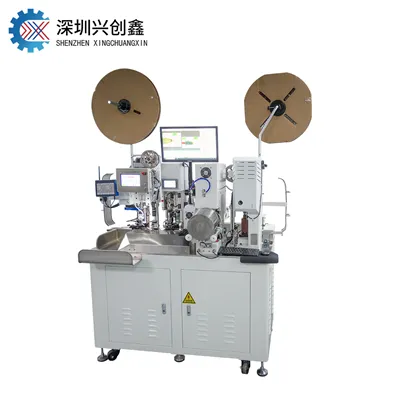
Choosing between a semi-automatic terminal crimping machine and a fully automatic double-head crimping machine for your small wire harness factory? Compare flexibility, output, cost and wire compatibility to find the right stripping and crimping solution.
Many small wire harness workshop owners face the same tough question. With limited capital and mixed orders, should you stick with a semi-automatic terminal crimper paired with a separate computer wire stripper, or invest in a fully automatic double-head terminal machine?
Automation is not always better. The best equipment is the one that matches your order structure, cash flow and wire types. Blindly upgrading to full-auto machines often leads to underutilized equipment, long changeover time and extended payback periods. On the other hand, relying only on semi-auto units may leave you struggling with labor shortage, inconsistent quality and tight delivery schedules when large orders arrive.
Semi-Automatic Terminal Crimper + Independent Wire Stripper: Flexible Setup for High-Mix, Low-Volume Orders
The biggest strength of semi-automatic crimpers is flexibility. The typical workflow: wires are cut and stripped by the wire stripper first, then fed manually into the crimper for terminal crimping. These machines have low upfront cost, a gentle learning curve and quick die change for new part numbers.
Best for these scenarios:
Frequent model changes, small batch sizes and many SKUs every day
Wide range of wire types: silicone wire, PTFE wire, sheathed cable, multi-core wire, special short wires and shielded wires
New workshop startup, sampling jobs and trial orders for overseas customers
Tight budget, avoiding heavy fixed asset investment
Advantages:
Great compatibility. Special wires and unusual terminals that are hard to run on double-head automatic machines can usually be processed on semi-auto crimpers.
Simple maintenance, fast troubleshooting and low spare part cost.
One wire stripper can feed multiple semi-auto crimpers to balance production.
Low risk. You will not be locked into fixed capacity when order volume fluctuates seasonally.
Note: Choose a servo semi-automatic crimper if your customers require quality traceability. It supports crimp force monitoring to meet IATF16949 requirements while keeping flexibility.
Limitations: Operators are required to feed wires manually. Productivity is limited and quality consistency depends heavily on operator skill. It is difficult to collect crimp curve data automatically for automotive or energy storage customers. Output hits a ceiling for mass production.
Fully Automatic Double-Head Terminal Machine: Efficient Solution for Stable Standard Orders
A double-head terminal machine integrates wire cutting, stripping and double-end crimping in one station. Equipped with servo systems, raw wire goes in and finished harnesses come out. Optional add-ons include crimp force monitoring and CCD visual inspection to detect stripping defects, missing terminals and stray conductor strands. One operator can supervise multiple units.
Best for these scenarios:
Standard electronic harnesses with stable repeat orders
Large order quantities for the same part number
Customers from industrial control, energy storage or automotive supply chain requiring quality records and traceability
High local labor cost, and the payback period is acceptable
Advantages:
Much higher throughput for double-ended wires.
Stable stripping dimension and crimp height, greatly reducing human-caused defects.
Built-in data logging, compatible with MES system for factory audit.
Less quality risk caused by staff turnover.
Limitations: Longer setup and changeover time. It demands consistent wire quality. It struggles with eccentric cables, large gauge high-voltage wires, shielded wires and special short wires. Initial purchase cost, die sets and maintenance expenses are higher. If your orders are fragmented, you will spend most of your production time on adjustment instead of running parts.
Quick Checklist to Make Your Decision
Go with semi-automatic crimper + separate wire stripper if at least two points apply:
More than 20 different part numbers per month, mostly small batches
Lots of sampling and prototype jobs
Mixed wire types including silicone, PTFE and shielded cables
Unstable order volume and obvious seasonal swings
Consider fully automatic double-head terminal machine if at least two points apply:
Steady repeat orders of standard double-ended wires
Regular bulk orders of tens of thousands of pieces per model
Customer requirements for crimp data traceability
Hard to hire workers and rising labor cost
Recommended Upgrade Path for Small Harness Factories
You do not have to pick only one option. Start with a servo semi-automatic crimper + computer wire stripper (V-blade or rotary blade optional) to handle samples and mixed small orders while building your customer base. When certain double-ended wire SKUs gain stable big orders, add one double-head automatic machine dedicated to those high-volume products. Keep your semi-auto lines for flexible small batches. This hybrid setup balances cash flow, production flexibility and product quality, and is widely adopted by export-oriented harness manufacturers.
Final Takeaway
Fully automatic double-head machines win on speed and consistency for stable mass orders. Semi-automatic combinations win on flexibility for high-mix low-volume production. Machines serve your orders, not the other way around. Semi-auto combinations are often the best value for workshops taking custom small-batch overseas orders. Automatic double-head machines help you gain pricing advantages only when you have consistent standard bulk jobs.
If you are not sure whether your wires and specifications fit our machines, send us your sample details. We provide free process evaluation and trial run service.