The wire harness industry is at a pivotal moment. The global market is projected to grow from $68.6 billion in 2025 to $93.8 billion by 2030, with wire processing machines reaching $2.6 billion by 2032. By 2027, new regulations, emerging technologies, and shifting demand will reshape how wire harnesses are designed and produced. Here's what lies ahead.
Market Growth Across Multiple Fronts
Three engines are driving growth: automotive electrification, industrial automation, and aerospace expansion.
Automotive remains the dominant force. The global automotive wiring harness market is projected to grow from $62.4 billion in 2025 to $78 billion by 2030. Electric vehicles are the primary catalyst-they require significantly more complex high-voltage wiring than conventional cars. With global EV penetration exceeding 35%, demand for high-voltage harnesses is accelerating rapidly.
Aerospace and defense are emerging as significant growth areas, driven by advancements in avionics and military equipment. Asia Pacific leads consumption, while North America is seeing reshoring accelerate.
Automation: The New Baseline
Automation is no longer a competitive advantage-it's table stakes.
At productronica 2025, major manufacturers demonstrated fully automated cells producing tested cable assemblies end-to-end. AI-powered robotic arms now manage flexible wiring with heightened precision, while laser-based processing handles ultra-thin wires without damaging the core.
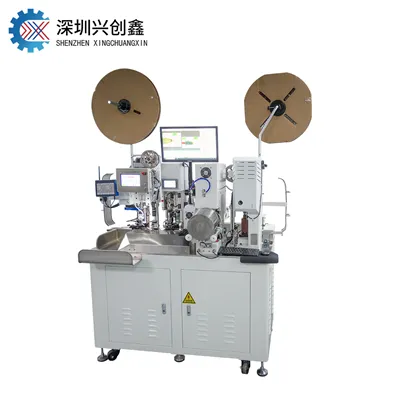
Multi-functional machines-combining cutting, stripping, and crimping in one unit-are the trend, reducing floor space and handling errors. With nearly 45% of manufacturers reporting skills gaps, automation isn't just about efficiency-it's about augmenting a shrinking skilled workforce.
Digitalization: From Design to Production
Digital tools are revolutionizing every stage.
Digital twins construct virtual replicas to simulate production, identify bottlenecks, and optimize processes before a single wire is cut. Design software now includes auto - dimensioning, cost estimation, and enhanced documentation capabilities.
Real-time monitoring tracks machine performance and detects issues instantly. End-to-end traceability is becoming mandatory-especially for automotive, aerospace, and medical applications where quality documentation is non-negotiable. Every crimp can be measured and verified, not just sampled.
High-Voltage, Lightweight, and Intelligent
High-voltage harnesses are the fastest-growing segment, projected to reach $24.1 billion by 2034 at a CAGR of 14.2%. Driven by 400V/800V EV architectures, these require specialized equipment capable of handling thicker, more rigid cables and stricter safety requirements.
Lightweighting drives demand for aluminum conductors, modular designs, and advanced materials-reducing weight and part counts. Intelligent diagnostics are being built into harness designs, with self-diagnostic capabilities and real-time health monitoring becoming key differentiators.
The 2027 EU Machinery Regulation
January 20, 2027 marks a critical deadline. The new EU Machinery Regulation (EU) 2023/1230 replaces the previous Machinery Directive 2006/42/EC.
The regulation updates safety, documentation, and cybersecurity requirements for modern technologies-including networked machines, AI, and safety-related software.
For equipment manufacturers: Machine builders must pay closer attention to safe construction practices. Cables and connection technology must be involved early in risk analysis. Technical data, tests, certificates, and product selection must be documented in a structured manner.
For harness manufacturers: Equipment must produce harnesses that meet the regulation's higher safety standards. If you sell into Europe, ensure your wire processing equipment complies by January 2027-this is not optional.
What This Means for Wire Harness Equipment Manufacturers


For companies selling wire stripping machines, terminal crimpers, and copper tape crimping machines, the next few years present clear imperatives:
Invest in automation-customers are moving toward fully integrated production cells
Prepare for high-voltage processing-thicker cables and stricter safety requirements
Embrace digitalization-equipment with IoT connectivity, data logging, and software integration
Get ahead of EU 2023/1230-compliance by January 2027 is non-negotiable
Focus on precision-quality requirements are tightening across all end markets
The wire harness industry in 2027 and beyond will be defined by automation, digitalization, electrification, and regulation. The market is growing fast-and the equipment market is growing even faster. Customers will demand more automation, more precision, more data, and more compliance. The companies that deliver will lead. Those that don't will be left behind.
The future isn't coming-it's already here. Are you ready for 2027?