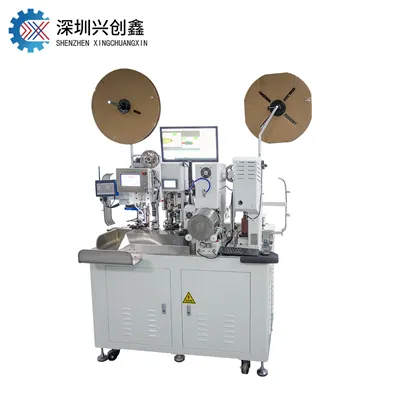
Wire stripping machines are mechanical devices used to remove the insulation layer from electrical wires and expose the conductor core. Primary types include intelligent computerised wire strippers, automatic wire strippers, and laser wire strippers. Different models are suitable for varying wire diameters, materials, and compositions: computer strippers for short fine wires, large cross-section wires, ribbon cables, sheathed cables, and coaxial cables. Wire strippers are among the most widely used machinery in the mechanical industry. People rely on various forms of mechanical automation in numerous settings, and wire strippers are particularly instrumental in enhancing production efficiency.
The following are the basic components of a wire stripper:
1. Feed roller: Conveys the wire and strips the wire ends. When stripping short wires (less than 50mm in length), the stripper removes both the front and rear ends. When stripping mid-length wires, it strips the front end and also has the capability to strip several sections in the middle.
2. Wire-Out Pulley: Conveys wire to the stripper and ejects the stripped end. (This pulley is inactive when stripping short wires; ensure the 'Wire-Out Pulley Lift Knob' is in the 'u' position).
3. Wire-In Pulley Gap Adjustment Knob: Regulates the gap between the wire-in pulleys. Turning clockwise increases the gap; turning anticlockwise decreases it (adjust according to wire thickness).
4. Wire Feeding Roller Pressure Adjustment Knob: Regulates pressure on the wire feeding roller. Pull out and turn clockwise to increase pressure; pull out and turn anticlockwise to decrease pressure. (Adjust according to the insulation strength of the wire – increase pressure for difficult insulation removal, decrease for easier removal).
5. Feed roller lift knob: Raises the feed roller during wire threading. Turn clockwise to lift the roller, facilitating smooth wire passage. During operation, lower the roller by turning counterclockwise to press the wire firmly.
6. Outgoing Wire Wheel Gap Adjustment Knob: Adjusts the outgoing wire wheel gap. Turning the knob upwards increases the gap; turning it downwards decreases the gap (adjust according to the wire's thickness).
7. Outgoing Wire Wheel Pressure Adjustment Knob: Adjusts the outgoing wire wheel pressure. Pull out the knob and turn it anticlockwise to increase pressure; pull out the knob and turn it clockwise to decrease pressure. (Determining this depends on the insulation strength of the wire material, i.e., the ease with which the wire stripper removes the insulation. Increase pressure for difficult insulation and decrease for easy insulation.)
8. Wire Exit Roller Lift Knob: Lifts the wire exit roller when removing the wire. Turn the knob anticlockwise to raise the roller, facilitating smooth wire removal. Lower the roller during operation by turning the knob clockwise. (When using the short stripping programme, the exit roller should be raised)
9. Blade Assembly: Responsible for cutting, stripping the front end, and stripping the rear end of the wire in the wire stripper. When the machine is stopped, the upper and lower blades must be opened to their maximum extent to ensure the wire passes smoothly through the cutting tools.
Precautions
1. Operating Power Supply: AC 220V ±10%, 50–60Hz. A voltage stabiliser must be provided to ensure proper machine operation.
2. Use the dedicated power cord supplied with this machine.
3. Ensure the operating environment is clean, free from dust, corrosive chemicals, and strong electromagnetic interference. Operating temperature range: -10°C to +35°C. Avoid placement in extremely cold or hot environments; ensure adequate ventilation.
4. Do not share the same power circuit with equipment that frequently operates relays, solenoids, or similar components.
5. Perform regular lubrication maintenance on mechanical transmission components.