I. Basic Concepts and Working Principle Differences
1.Semi-Automatic Terminal Crimping Machine
A semi-automatic terminal crimping machine is a wire harness processing device that requires manual participation in part of the operation, mainly completing the crimping of wire terminals. Its typical workflow is:
Manual insertion of the wire into the terminal die
The equipment automatically completes the crimping process
The operator removes the finished product and places new wire material
2.Fully Automatic Terminal Crimping Machine
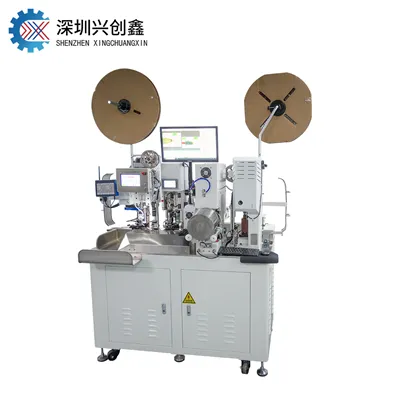
A fully automatic terminal crimping machine is a highly integrated automated processing system capable of independently completing the entire process from wire feeding to finished product output:
Automatic wire feeding system precisely controls wire length
Automatic stripping mechanism removes the insulation layer
Automatic terminal feeding device supplies terminals
Automatic crimping unit completes the terminal connection
Finished products are automatically collected or transferred to the next process
II. Core Performance Comparison
|
Comparison Item |
Semi-automatic Terminal Crimping Machine |
Fully-automatic Terminal Crimping Machine |
|
Production Efficiency |
Relatively low (300–500 cycles/hour) |
Extremely high (1500–5000 cycles/hour) |
|
Labor Requirement |
Dedicated operator required |
One operator can monitor multiple machines |
|
Precision Control |
Approximately ±0.2 mm |
Within ±0.05 mm |
|
Applicable Wire Cross-section |
Usually 0.5–6 mm² |
0.08–10 mm² (wider range) |
|
Model Changeover Time |
5–15 minutes |
30 minutes – 2 hours (including program debugging) |
III. Application Scenario Analysis
1.Situations Suitable for Semi-Automatic Terminal Crimping Machines
Small-batch, multi-variety production: More flexible when wire specifications are changed frequently
R&D prototyping stage: Convenient for quickly validating design solutions
Small and medium-sized enterprises with limited funds: Low initial investment cost
Special wire processing: Such as extra-thick wire gauges or irregular terminals
2.Advantage Areas of Fully Automatic Terminal Crimping Machines
Large-batch standardized production: Automotive wire harnesses, home appliance wiring, etc.
High-precision requirement scenarios: Medical equipment, aerospace cables
24-hour continuous operation: In conjunction with automated production lines
Regions with high labor costs: Significantly reduces dependence on manual labor
IV. Technical Detail Differences
1.Wire Feeding System
Semi-automatic: Manual wire feeding, dependent on operator experience
Fully automatic: Servo motor-driven, equipped with force sensors and visual deviation correction
2.Terminal Feeding
Semi-automatic: Vibratory bowl feeder or manual loading
Fully automatic: Intelligent reel system with material shortage alarm function
3.Quality Control
Semi-automatic: Manual sampling inspection
Fully automatic: In-line inspection (pull force testing, continuity testing, etc.)
4.Data Management
Semi-automatic: No data recording
Fully automatic: MES system integration, traceable production data
V. Selection Recommendations and Precautions
1.Factors to Consider in Purchasing
Production demand: Semi-automatic can be considered for monthly output below 100,000 units
Product consistency requirements: High-precision products must use fully automatic machines
Future development plans: Consider equipment upgrade space
Maintenance capability: Fully automatic machines require professional technicians
2.Usage Precautions
Semi-automatic machines: Focus on training operating procedures to avoid human errors
Fully automatic machines: Regularly calibrate sensors and keep the environment clean
3.Upgrade and Retrofit Solutions
Semi-automatic machines can be equipped with: Automatic wire feeding modules, simple inspection devices
Fully automatic machines can be expanded with: AGV integration, intelligent warehousing interfaces
VI. Industry Development Trends
Semi-automatic equipment is evolving toward "intelligent assistance":
Addition of visual guidance systems
Installation of error prevention devices
Integration of simple data acquisition
Fully automatic equipment is showing characteristics of "flexible production":
Rapid changeover technology (<5 minutes)
Adaptive processing algorithms
Modular design
Hybrid equipment is emerging:
Automated equipment that retains manual intervention interfaces
Production mode can be switched according to order volume