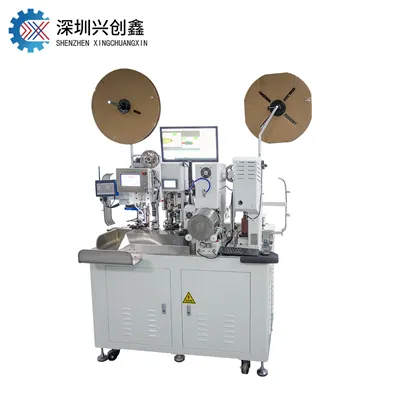
High Persistent Defect Rate in Terminal Crimping? Dissecting Four Major Root Causes from the Equipment Perspective
Terminal crimping is a core process for wire‑harness manufacturing. Many production lines face the problem of chronically high crimp defect rates, even after optimizing operators and raw materials. Most recurring defects stem from equipment‑related root causes rather than manual operation. Below is a breakdown of four major equipment‑driven root causes.
1. Crimping system: insufficient closed‑loop control & aging mechanical transmission
Traditional open‑loop crimpers only rely on mechanical stop blocks to control crimp height. Long‑term impact wear of cams, bearings and slide blocks will introduce gradual mechanical clearance. As a result, actual crimp height drifts beyond tolerance, triggering unstable crimp quality.
Without Crimp Force Monitor (CFM) force‑displacement curve real‑time monitoring: hidden defects such as partial strand under‑crimping, foreign‑object inclusion and terminal‑die jamming cannot be captured; defective products flow downstream without alarms.
Servo‑crimping units with aging drive components will produce inconsistent crimp stroke, leading to fluctuating compression ratio even with identical parameter settings.
Typical defects: unstable pull‑off force, intermittent poor crimping, qualified‑but‑unreproducible first‑article validation.
2. Die & tooling system: precision loss, misalignment and improper matching
Crimp dies are high‑consumption wearing parts. Tooling failure is a frequent yet easily overlooked source of defects.
Die wear: long‑term stamping causes die cavity abrasion, burrs and deformation, which damage terminal material and result in uneven crimping contours.
Poor coaxial alignment: offset between wire guide, terminal positioning fixture and crimp die. Off‑center feeding leads to one‑sided crimp deformation, conductor strand overflow and strand breakage. This issue becomes more prominent for fine‑gauge wires (26‑32 AWG) and high‑speed Ethernet harness terminals.
Mismatched die‑terminal specification: re‑using old dies for new terminal models causes improper crimp‑wing wrapping, leading to hidden mechanical‑strength risks.
Typical defects: burrs, strand overflow, broken copper strands, crimp‑wing warping, low pull‑off force.
3. Wire feeding & clamping mechanism: unstable wire positioning before crimping
Even with perfect crimp hosts and dies, defective crimps will occur if the incoming wire positioning is unstable.
Insufficient or excessive clamping force: too little clamping force causes wire displacement during crimping; over‑clamping crushes conductors or insulation, especially fatal for foamed‑insulation high‑speed cables.
Worn wire guides and conveying rollers: wire swing and position offset happen during feeding; twisted‑pair twisting and stretching may occur for differential‑pair cables.
Absence of pre‑stop positioning: wire end floats, resulting in inconsistent insulation‑barrel insertion depth, causing insulation squeeze‑in or bare‑conductor overhang.
Typical defects: variable insulation‑barrel position, wire displacement, random crimp dimensional deviation.
4. In‑line inspection capability deficiency: unable to intercept latent defects in real time
Many workshops still rely on periodic sampling pull‑force tests and manual visual inspection. These methods cannot achieve 100 % real‑time interception.
Lack of 2D/3D vision inspection: invisible defects such as micro‑strand breakage, tiny strand overflow and crimp‑flare abnormality escape manual checking. For high‑speed Ethernet harnesses, parts may pass pull‑force tests but produce impedance discontinuity points.
No data‑linkage alarm mechanism: equipment generates abnormal process data but does not trigger automatic rejection; defective products continue to flow into subsequent assembly and testing stations.
No recipe‑locking management: operators can arbitrarily modify crimp‑stroke and feeding‑position parameters without records, creating unregulated process drift.
Typical defects: latent hidden bad pieces, sporadic random defects difficult to reproduce during troubleshooting.
Closing Summary
High crimp‑defect rate is rarely caused by a single factor. Mechanical wear of crimping host, die‑tooling precision loss, unstable wire‑feeding fixtures and insufficient online monitoring often overlap. For high‑speed Ethernet and fine‑gauge wire harness production, upgrading to closed‑loop servo crimping, high‑precision tooling, stable clamping‑feeding and integrated vision‑plus‑CFM monitoring is the fundamental equipment‑oriented solution to reduce crimp failure rate.